Europe’s climate policy is anchored to a single political milestone: climate neutrality by 2050. The European Green Deal frames this objective as both an environmental and economic transformation. The timeline is clear, measurable, and embedded in legislation.
Yet landfill methane in Europe follows a different timeline — one dictated not by political commitments, but by biology and atmospheric physics.
A major European study published in 2026 projects methane emissions from municipal landfills across the EU-27 and the United Kingdom through 2130. Its findings suggest that landfill methane in Europe represents one of the most persistent and underestimated sources of long-term greenhouse gas emissions in the European climate framework.
The 37% Post-2050 Emissions Reality
The most striking conclusion of the study is this: approximately 37% of methane emissions generated between 2022 and 2050 will be released after 2050.
This single figure changes the climate conversation.
Even if landfill volumes decline sharply over the next decades, even if recycling targets are achieved under existing EU waste policy, methane already embedded in landfill deposits will continue escaping into the atmosphere for decades.
Climate neutrality accounting does not eliminate delayed emissions. It only reshapes how they are reported.
Landfill methane in Europe is therefore not just a current emissions issue. It is a programmed future emissions problem.
The Scale of Methane Emissions in Europe’s Waste Sector
Under a continuation scenario aligned with current European waste legislation, cumulative methane emissions from landfills generated between 2022 and 2050 — assessed through their atmospheric impact until 2130 — could exceed 1.5 billion tonnes of CO₂-equivalent.
That scale places landfill methane emissions in Europe in the same order of magnitude as the annual emissions of several industrial economies.
Despite this, methane from the European waste sector rarely dominates climate discussions. Energy production, heavy industry, and transport electrification attract political attention. Meanwhile, landfill methane in Europe remains structurally embedded in decades of disposal practices.
Unlike fossil fuel combustion, landfill emissions cannot be rapidly switched off. Once organic waste is buried, anaerobic decomposition continues for decades.
Why Methane Is a Short-Term Climate Multiplier
Methane differs from carbon dioxide in a critical way. While its atmospheric lifetime is shorter, its warming potential in the first twenty years after release is significantly stronger.
When evaluated over a 20-year period, methane’s warming effect is nearly three times higher than when assessed over a 100-year horizon.
This methodological distinction has political consequences. If short-term warming thresholds and climate tipping points are considered central to EU strategy, landfill methane in Europe becomes a far more urgent problem than long-term averages might suggest.
The way methane is calculated influences the urgency assigned to its mitigation.
Europe’s Landfills as Long-Term Emission Reservoirs
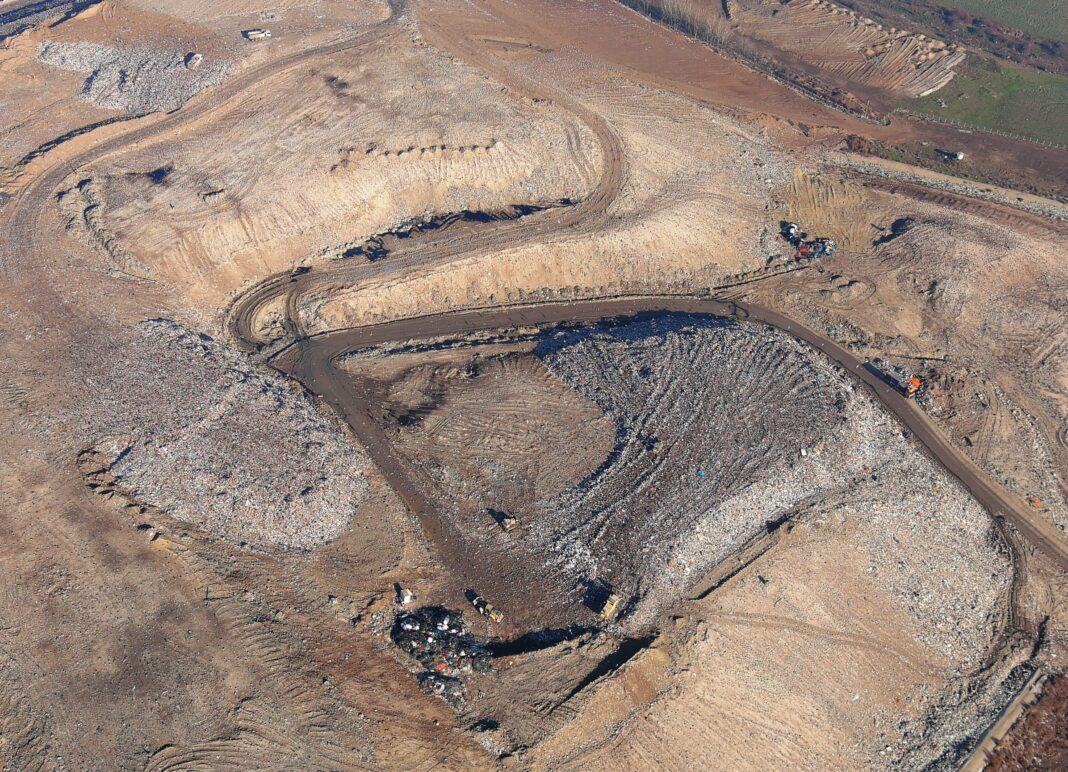
Europe hosts thousands of active and closed landfill sites. Many older facilities were developed before strict methane capture requirements were consistently enforced.
Even modern gas capture systems rarely achieve full efficiency. A fraction of methane inevitably escapes as fugitive emissions.
This means landfill methane in Europe functions as a long-term greenhouse gas reservoir. It represents delayed climate impact embedded in historical consumption patterns.
Unlike a coal plant, a closed landfill cannot be dismantled to stop emissions. The biological process continues underground, independent of political timelines.
Policy Coherence and Structural Blind Spots
The European circular economy framework aims to reduce waste generation and increase resource efficiency. However, without rapid diversion of biodegradable waste from landfills, methane emissions in Europe will remain structurally embedded.
If more than one-third of methane emissions generated this decade will materialize after 2050, then EU climate neutrality strategies must account for waste-sector inertia more explicitly.
Stronger organic waste diversion, improved methane capture efficiency, and stricter monitoring of landfill emissions are essential if landfill methane in Europe is to align with long-term climate goals.
Beyond 2050: A Longer Climate Horizon
Europe may reach net-zero greenhouse gas accounting by mid-century. Yet methane already embedded in landfill systems will continue influencing atmospheric warming well beyond that milestone.
Climate transition is not only about reducing new emissions. It is about managing emissions already encoded in infrastructure and past waste practices.
Under Europe’s soil lies a delayed greenhouse force. Recognizing landfill methane in Europe as a structural climate risk is essential if climate neutrality is to reflect physical reality rather than statistical achievement.